Compliance vs. Security: What’s the Difference and Why It Matters
Passing an audit can make a business feel like it has all its bases covered. The policies are written, the documentation is complete, and the required controls are in place. But compliance and security are not the same thing.
A company may have documented backup procedures, but has anyone tested how quickly critical data can be restored after an outage? There may be an incident-response plan, but has the team practiced using it? Employees may complete required cybersecurity training each year, but would they recognize a sophisticated phishing email tomorrow?
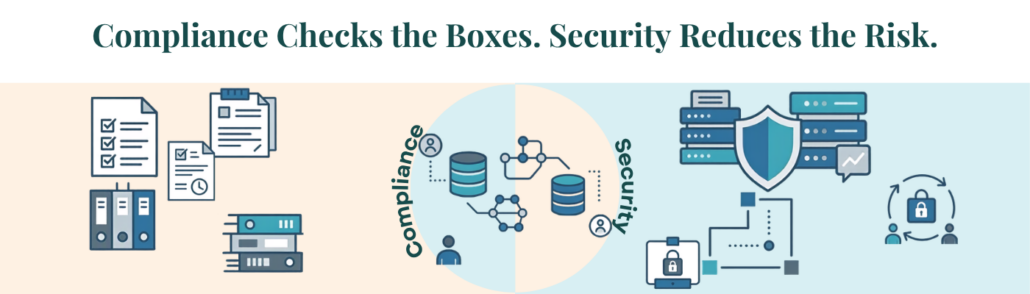
These questions highlight a common misunderstanding. Compliance demonstrates that an organization has met specific requirements. Security focuses on reducing risk, protecting operations, and ensuring the business can respond effectively when something goes wrong.
Compliance Provides the Foundation
Compliance refers to following the laws, regulations, standards, or contractual requirements that apply to a business. Depending on the industry, that may include HIPAA, PCI DSS, GDPR, CMMC, NIST, or another cybersecurity framework.
These standards establish expectations for how organizations should handle and protect sensitive information. They often require organizations to implement policies, employee training, access controls, encryption, monitoring, vendor management, backups, and incident-response procedures. For many businesses, compliance provides valuable structure by defining responsibilities, establishing processes, and creating documentation that auditors, customers, regulators, and insurance providers may expect to see.
However, compliance often focuses on evidence. Can you provide the policy? Can you show the training records? Can you demonstrate that your team is using the control effectively? Those questions matter, but they do not always answer the most important one: Is this actually reducing risk?
Security Focuses on Risk
Security goes beyond documentation and checklists. It is the ongoing process of protecting systems, data, employees, and business operations from disruption.
A strong cybersecurity strategy begins with understanding how the organization actually functions. Where does the organization store sensitive data? Who has access to critical systems? Which technologies are essential to daily operations? How would the business operate if those systems went offline?
The answers help determine which protections are most important. That may include multi-factor authentication, endpoint protection, vulnerability management, software patching, access reviews, employee awareness training, network monitoring, and disaster-recovery planning.
Security must also evolve alongside the business. New cloud platforms, remote employees, vendors, devices, and applications can all introduce new risks. At the same time, cyber threats continue to change, with phishing attacks becoming more convincing, ransomware tactics evolving, and attackers constantly looking for overlooked weaknesses.
A simple way to distinguish the two is this: compliance asks, “Can we prove we met the requirement?” Security asks, “Are we adequately reducing risk?”
Compliance vs. Security: Why Businesses Need Both
One of the most common misconceptions is that compliance automatically means protection. Compliance standards are important, but they are designed to establish a baseline and cannot account for every threat, technology change, employee mistake, operational challenge, or business-specific risk.
User access management provides a good example. A company may have a documented process for granting and removing access to systems. On paper, the company may fully satisfy that requirement. In practice, however, permissions can accumulate over time, leaving employees with access they no longer need. Similar issues can occur with cloud applications, third-party vendors, mobile devices, and other areas of technology.
This is where risk often hides. The documentation may be complete, the controls may exist, and the audit may be successful, yet significant security gaps can still remain. Compliance should be viewed as one component of a cybersecurity strategy, not the strategy itself.
How Compliance and Security Work Together
Although they serve different purposes, compliance and security work best when they support one another. Compliance provides the framework, while security provides the ongoing testing, monitoring, and management that make that framework effective.
For example, a compliance requirement may require organizations to protect sensitive information. Security turns that requirement into practical actions such as implementing multi-factor authentication, reviewing user access, monitoring activity, and enforcing effective offboarding procedures. Likewise, a compliance standard may require employee cybersecurity training, while security ensures that the training remains relevant, practical, and aligned with current threats.
When compliance and security are connected, businesses gain more than audit readiness. They gain better visibility into risk, greater resilience, and a stronger ability to respond effectively when issues arise.
Compliance Is Not the Finish Line
Compliance helps organizations understand what is required, while security and risk management help determine what is necessary. That distinction becomes increasingly important as businesses grow, adopt new technologies, support hybrid work environments, and rely more heavily on third-party vendors.
A stronger approach begins with treating compliance and security as part of the same conversation. Businesses should understand the requirements that apply to them and evaluate whether their security controls reflect how they actually operate and the risks they face every day.
At Epoch IT, we help organizations bridge the gap between compliance requirements and practical cybersecurity strategies. Through managed IT services, network monitoring, cybersecurity support, disaster-recovery planning, and employee training, we help businesses strengthen the systems and processes they depend on most.
Compliance matters. It demonstrates accountability, helps protect sensitive information, and establishes a foundation for cybersecurity. But the goal is not simply to pass an audit—it’s to reduce risk, protect critical operations, and make informed technology decisions before problems arise.
Building the Standard
Not sure what level of IT support your organization needs? Talk with our team about a plan built for reliability, security, and long-term growth.
Schedule a Free Consultation